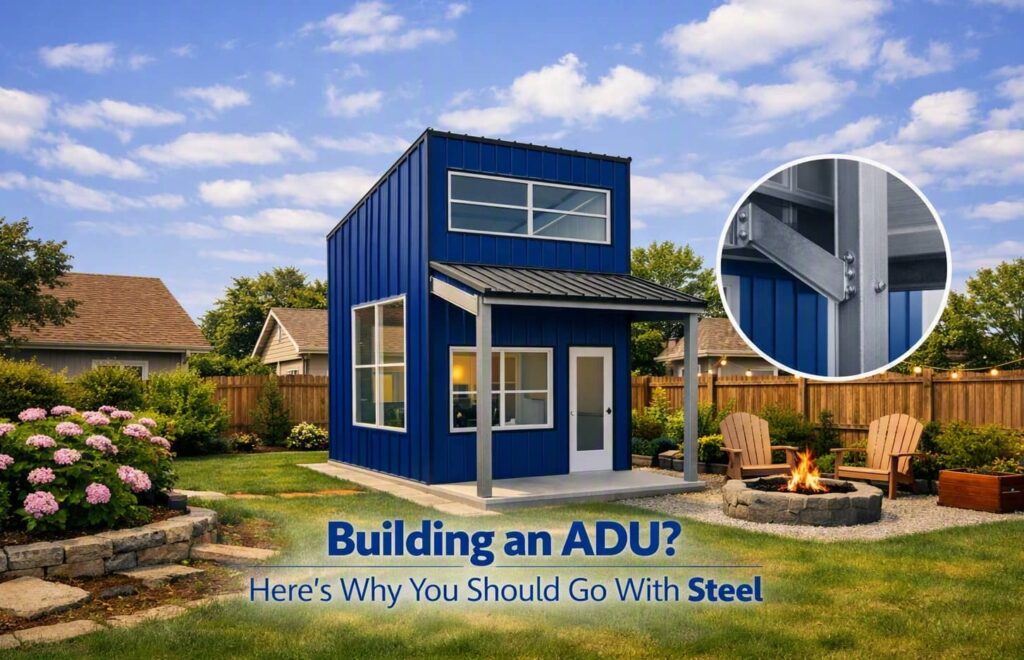
If you are planning to add an Accessory Dwelling Unit to your property, you are making one of the smartest investments available to homeowners today. Whether the goal is long-term rental income, a private space for aging parents, or a guest suite for visiting family, an ADU adds both square footage and lasting value to your property. Before you break ground, though, you face a decision that will shape the project’s budget, timeline, and decades of future performance: what material should frame the structure. Wood has been the default choice for generations, but steel framing has emerged as the clearly superior alternative for homeowners who think beyond the initial price tag.
Understanding ADUs: What They Are and Why They're Booming
Zoning reforms across the country are fueling this boom. States like California, Massachusetts, New York, and Colorado have streamlined the approval process for ADUs in residential zones, recognizing them as a practical way to increase housing density without altering neighborhood character. Massachusetts alone recorded over 1,600 ADU applications in 2025. New York City formally defined ADUs in its zoning code for the first time in late 2024, opening the door for thousands of homeowners to build.
Amid all this momentum, the framing material you select is the single most consequential choice you will make. It determines the structure’s lifespan, its maintenance burden, its insurance costs, and its ability to withstand the elements. Wood has been the default for decades. Steel is the smarter choice for homeowners who want their investment to pay off for generations.
Steel vs. Wood: The Core Comparison for ADU Construction
Durability and Lifespan
Steel does not rot. It does not warp, split, or crack over time, and when properly coated with rust-preventing treatments, it resists corrosion for decades. Wood, by contrast, is an organic material that absorbs moisture, swells, shrinks, and eventually breaks down. In humid climates or regions with heavy rainfall, wood framing is a liability that demands constant vigilance.
Pests are another factor that tilts the scale decisively toward steel. Termites and carpenter ants can devastate a wood-framed structure, requiring chemical treatments and ongoing inspections to keep infestations at bay. Steel is simply not on the menu. No insect will ever compromise the structural integrity of a steel ADU.
Then there is the question of structural strength. Steel buildings withstand high winds, heavy snow loads, and seismic activity better than wood-framed structures. They hold their shape under stress that would crack or shift lumber. This is why most steel building manufacturers back their products with lifetime structural warranties, while wood framing typically carries defect coverage that runs between 10 and 30 years.
Fire Resistance and Insurance Implications
Steel is non-combustible. It does not ignite, it does not fuel a fire, and it does not collapse as quickly under extreme heat. This is a critical safety advantage whether your property sits in a wildfire-prone region of the West or in a dense urban neighborhood where homes stand close together.
Insurance carriers recognize this difference and price their policies accordingly. Homeowners who have compared quotes report that premiums for steel buildings can run roughly half the cost of equivalent wood structures. In areas where wood-framed buildings face coverage restrictions, higher deductibles, or outright policy non-renewals, a steel ADU can mean the difference between affordable insurance and a property that is difficult to protect.
Cost Considerations: Upfront and Long-Term
The most persistent misconception about steel ADUs is that they are prohibitively expensive. In reality, steel kits and post-frame construction methods reduce labor time and material waste, narrowing the upfront cost gap with wood significantly. Many homeowners find that the structure itself is nearly identical in price to a wood-framed equivalent.
The real financial advantage of steel emerges over time. A steel ADU requires virtually no maintenance throughout its lifetime. There is no painting, no sealing, no pest control, and no repair or replacement of damaged framing members. Wood, on the other hand, demands all of these things. Factor in the insurance savings and the extended lifespan, and the long-term cost picture favors steel by a wide margin.
Design Flexibility: Clear-Span Steel Opens Up Your ADU Layout
One of the most underappreciated advantages of steel framing is the design freedom it provides inside the structure. Steel’s strength allows for clear-span framing, which eliminates the need for load-bearing interior walls. This means the entire square footage of your ADU is open and usable from the start.
For an ADU, where every square foot counts, this flexibility is invaluable. The same footprint can be configured as a studio, a one-bedroom, or a two-bedroom layout depending on the needs of the occupant. If those needs change over time, interior walls can be added, removed, or reconfigured without any structural modifications. Wood framing locks you into a floor plan. Steel lets you adapt.
Pre-engineered steel packages from ROI Metal Buildings are tailored specifically for residential secondary housing. These kits arrive ready to assemble, with components designed to work together seamlessly. Steel’s dimensional stability also means that doors and windows stay square and operate smoothly for decades. Wood shifts and settles over time, leading to sticking doors, cracked drywall, and gaps that leak conditioned air.
Insulation and Energy Efficiency: Making Your Steel ADU Comfortable Year-Round
A common concern among homeowners considering steel is whether the building will be difficult to insulate. The concern is understandable but outdated. Modern insulation systems have made steel buildings as energy-efficient as any wood-framed structure, and often more so.
Continuous insulation or spray-foam packages create an effective thermal envelope that prevents condensation and eliminates thermal bridging, the phenomenon where heat transfers through framing members. When you address thermal bridging in metal buildings with the right materials and installation techniques, the result is a tight, efficient shell that keeps interior temperatures stable year-round.
This efficiency translates directly into lower utility bills, whether you are paying them or your tenant is. Paired with a properly sized mini-split HVAC system, a well-insulated steel ADU can be heated and cooled for a fraction of what a drafty wood-framed structure costs. The tight building envelope also provides superior sound insulation, an often-overlooked benefit when your ADU sits close to the main house or to neighboring properties.
Navigating Zoning, Regulations, and HOA Requirements for Steel ADUs
Understanding Local Zoning Rules
Municipal codes typically dictate ADU size limitations, which commonly range from 400 to 1,200 square feet, along with setback requirements and utility connection standards. State-level reforms are making the process easier. Colorado now streamlines detached ADU approvals in residential zones. Massachusetts allows ADUs up to 900 square feet by-right in single-family zoning districts, with no requirement for owner occupancy. New York State caps ADUs at 800 square feet of zoning floor area and requires the owner to be the primary resident of the property.
Before committing to a design, verify your local requirements. Steel kits can be customized to meet specific size and height restrictions, so there is rarely a regulatory barrier that cannot be cleared with the right planning.
Working With HOAs and Aesthetic Requirements
Homeowners’ associations can be a sticking point, but they are rarely a dealbreaker. Many HOAs have blanket prohibitions on metal buildings, but these rules typically target structures with exposed steel siding and roofing, the kind you see on agricultural or industrial buildings. Most HOAs will approve a steel-framed structure if it is finished with traditional exterior materials.
Stucco, brick, vinyl siding, and even tile roofing can all be applied over steel framing. Once the building is complete, the steel frame is completely invisible. The finished ADU looks like any other residential structure in the neighborhood while delivering superior structural performance beneath the surface. Work with your steel building provider to specify exterior finishes that satisfy HOA covenants from the outset, and you will avoid conflicts before they start.
Is a Steel ADU Right for You? Key Takeaways
Frequently Asked Questions About Steel ADUs
Are steel ADUs more expensive than wood?
Not necessarily. Material efficiency, faster construction, and reduced labor often make steel comparable to wood upfront, and the savings on maintenance and insurance make it cheaper over the building’s lifetime.
Can I get a mortgage or financing for a steel ADU?
Yes. Steel buildings are insurable and appraisable like any other residential structure. Government programs such as New York City’s Plus One ADU Program and Massachusetts’ ADU Incentive Program offer grants and low-interest loans for eligible homeowners.
Will a steel ADU look like a metal shed?
No. Steel framing can be finished with any traditional exterior siding, including stucco, brick, vinyl, and wood-look materials, along with standard roofing. The finished building is indistinguishable from conventional construction.
How long does a steel ADU last?
Steel buildings routinely last 50 years or more with minimal maintenance. Most manufacturers back their structures with lifetime warranties, something no wood framing supplier can match.
Conclusion: Build Smart, Build Steel
Steel outperforms wood on durability, safety, cost, and design flexibility. It gives you a structure that will not rot, will not burn, and will not attract termites. It keeps insurance costs low and adapts to whatever floor plan your future requires. The ADU you build today should serve your family for generations, and steel is the material that makes that possible. When you are ready to explore steel building packages for your project, ROI Metal buildings specializes in residential metal buildings and understand the specific demands of accessory dwelling units. The choice of framing material is one you will live with for decades. Make it steel.